Female Fertility
How does female fertility develop?
Female fertility is most affected by age. Biological aging cannot be stopped by a good lifestyle.
Until the age of 30, fertility declines gradually and after 35 the decline is sharp.
- Women are born with all their eggs
- Both egg quality and number decline with age
- The AMH test shows the number of remaining eggs
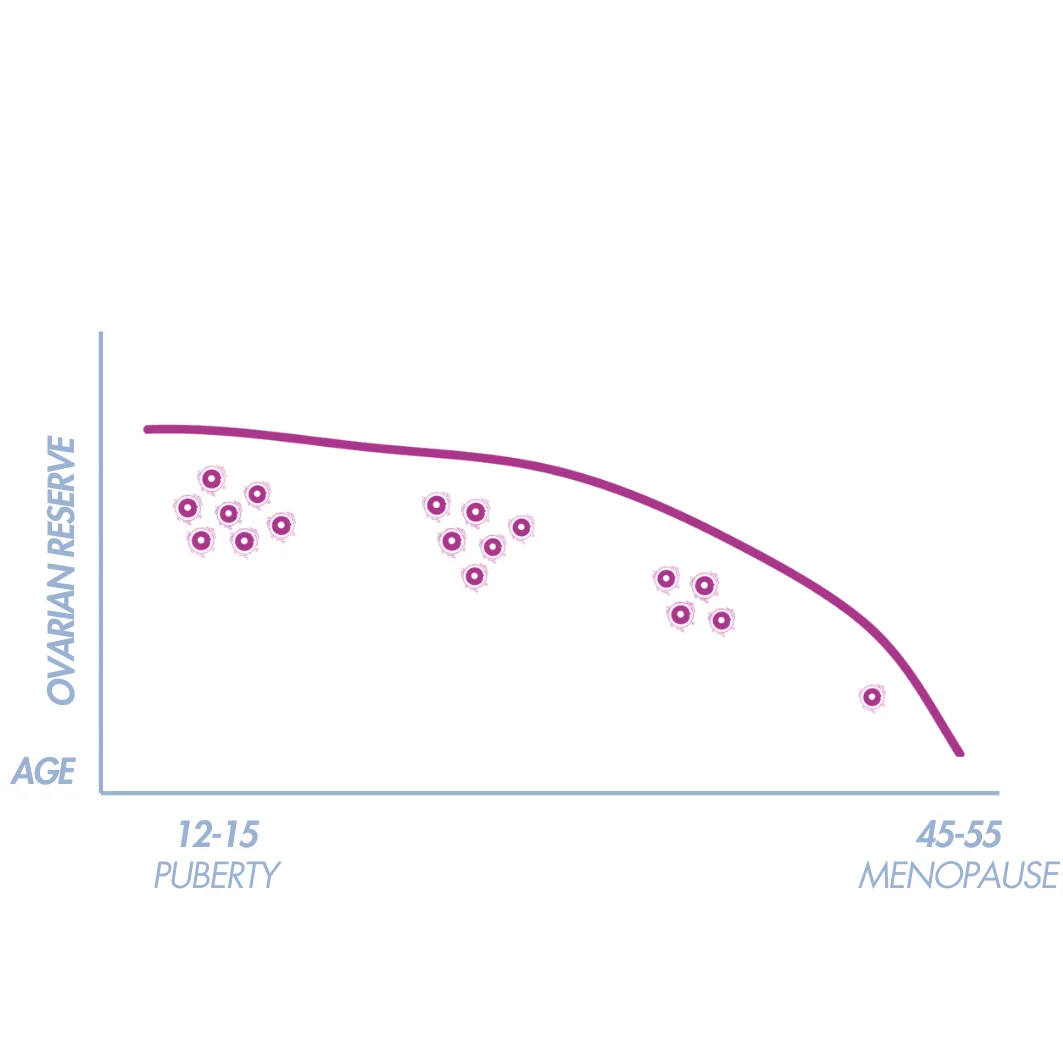

Number of eggs
A woman is born with a certain number of eggs, which throughout her life only declines and cannot be increased.

Egg quality
Women have the highest egg quality around the age of 25 (approximately 80% high-quality eggs), but after age 35 this proportion significantly declines. Around age 40, a woman has on average only about 20% high-quality eggs.

Morphological factors
Fertility is also affected by how the internal reproductive organs look and function - that is, the ovaries, fallopian tubes, uterus, and lining.
How does the female fertility examination take place?
All examinations are planned with your attending physician and we will explain their procedure and why they are important.
What are the basic examinations?
- AMH hormone level:
AMH (Anti-Mullerian hormone) is an indicator of a woman's ovarian reserve (egg count).
The examination is performed: from a blood sample, on any day of the cycle, even while taking hormonal contraception. It is considered a marker of the highest validity and a significant indicator of ovarian aging. A decreased AMH value is an indication for egg freezing to preserve fertility. However, AMH does not indicate egg quality. - Ultrasound examination:
Our specialists examine the uterus, fallopian tube patency, and ovaries - the essential organs necessary for conception.
What are the supplementary examinations and what do they reveal?
- Ovulation monitoring: we monitor whether and when ovulation occurs. Ultrasound as well as a hormonal profile help us with this.
- Hormonal profile: includes a series of tests for hormones that are key to ovulation and female fertility.
The most commonly tested hormones include:
- FSH (follicle-stimulating hormone) - helps regulate egg growth in the ovaries.
- LH (luteinizing hormone) - stimulates the release of the egg from the follicle during ovulation.
- Estrogen (estradiol) - responsible for egg maturation and preparation of the uterus for pregnancy.
- Progesterone - important for maintaining pregnancy after ovulation, as it supports the preparation of the uterus for receiving the fertilized egg.
- Prolactin - high levels can affect ovulation.
- AMH (anti-Mullerian hormone) - indicates the egg reserve and their quality. - Fallopian tube patency: helps determine whether the fallopian tubes are patent and thus whether the woman can conceive spontaneously. During this examination, a contrast foam based on sucrose is applied through the cervix using a thin catheter, which highlights the pelvic area. The doctor can then determine whether the fallopian tubes are patent.
If the examination reveals that both fallopian tubes are blocked - the woman cannot conceive spontaneously and we recommend using assisted reproduction methods. - HyFoSy: is an outpatient ultrasound examination used to determine fallopian tube patency and assess the contours of the uterus. A foam contrast agent is used during the procedure, which provides better accuracy than saline solution. The examination is safe, does not require hospitalization or general anesthesia, and does not involve X-ray radiation or iodine contrast agents. Results are available immediately, and it is best to interpret them directly during the examination.
What are the most common problems that affect female fertility?
- Woman's age: after age 30, both the number and quality of eggs decline; after 35, the decline is more pronounced.
- Hormonal disorders: e.g. polycystic ovary syndrome (PCOS), thyroid disorders.
- Anatomical obstacles: adhesions, fibroids, endometriosis, fallopian tube damage.
- Weakened ovulation or its absence: a cycle without ovulation = no chance of fertilization.
- Inflammations and infections: especially untreated or recurrent infections of the reproductive tract.
- Autoimmune diseases: e.g. celiac disease, lupus, antiphospholipid syndrome.
- Lifestyle: stress, smoking, underweight or overweight, lack of sleep.
- Unknown causes: up to 10-15% of couples have so-called idiopathic (unexplained) infertility.
How does endometriosis affect female fertility?
Endometriosis is a chronic inflammatory disease that can significantly reduce the chances of conception. Endometriosis occurs in 25-40% of women with conception problems. It is often accompanied by painful menstruation, pain during intercourse, or pelvic pain without a clear cause.
Diagnosis is made using ultrasound or laparoscopy. Before any surgery, we recommend examining the ovarian reserve (AMH) - this allows us to evaluate the chances of conception before and after the procedure.
At GYN-FIV, we offer comprehensive care, including consultations with assisted reproduction specialists, collaboration with a nutritional therapist, and a gynecological physiotherapist.
When is reproductive immunology examination recommended for infertility?
If conception is unsuccessful and anatomical, hormonal, infectious, or genetic causes have been ruled out, the next step may be an immunology examination. Reproductive immunology looks for causes of infertility in disorders of the immune system.
Examinations are recommended by the assisted reproduction center physician, especially in cases of:
- recurrent spontaneous miscarriages,
- unsuccessful artificial fertilization,
- known autoimmune diseases in the family,
- problems with carrying a pregnancy to term.
As part of the diagnostics, the following are examined: cellular immunity, antibodies against sperm, ovaries or zona pellucida, and screening for autoimmune diseases (e.g. antiphospholipid syndrome, celiac disease, thyroid diseases). After evaluating the results, the immunologist proposes an individual treatment plan in cooperation with the physician of the assisted reproduction center. Contact information for the specialist and instructions for booking are provided to patients directly by their physician.